
The first self-learning AI quant
THREEPIO
Reads the researchBuilds the strategiesTrades the book
An AI quant research system that reads the trading literature, builds strategies from it, and then spends eight stages trying to destroy them.
Most don’t survive. That’s the point.
A research pipeline, running end to end
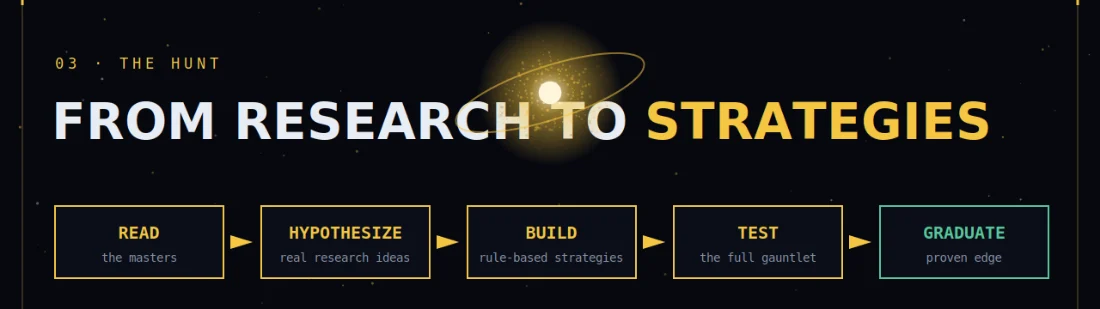
Threepio isn’t a set of indicators bolted together, and it isn’t a signal group with a bot attached. It reads, it builds, it tries to break what it built, and it trades what survives — then learns from how that went.
- 01
It reads
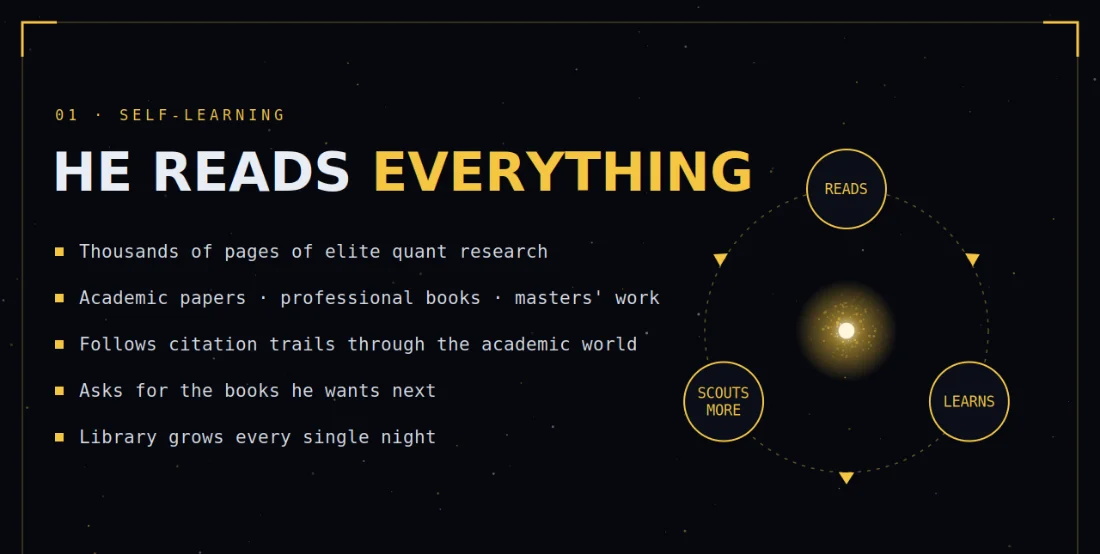
Thousands of pages of quant research — academic papers, professional books, masters’ work. It follows citation trails through the academic world, asks for the books it wants next, and the library grows every night.
- 02
It forms its own hypotheses
Each one is split into notes and bricks — the reasoning on one side, the reusable mechanics on the other. It takes the underlying mechanic, not the headline claim.
- 03
It builds strategies
Notes and bricks are recombined into strategy candidates, and their parameters are swept across the data.
- 04
It tries to destroy them
Every candidate is backtested and then validated: in-sample and out-of-sample tests, Monte Carlo resampling, luck filters and a deflated Sharpe test. The eight stages are set out below.
- 05
Survivors are sorted by regime
What lives through validation is assigned to the market regime it actually specialises in, and added to the strategy portfolio.
- 06
The portfolio trades your account
Threepio connects the portfolio directly to your account and runs the strategies that suit the current regime and conditions — swapping out the ones that don’t as conditions change.
- 07
It journals everything, and learns
Every trade is logged and journalled, winners and losers alike. That record feeds back into how the portfolio is managed next. It doesn’t stand still.
Eight stages, built to kill it
They run in order and the gauntlet stops at the first failure. A strategy that fails stage two never costs the compute of stage three. The bar doesn’t move — not for a promising result, not for a strategy anyone likes.
- 01
Sweep neighbourhood
Looks at the candidate’s neighbours in parameter space. If the settings either side of it lost money, this is a lone spike, not an edge — killed before anything expensive runs.
- 02
Cost sensitivity
Re-runs the whole thing with an extra tick of slippage per side. An edge that dies of one tick was never an edge.
- 03
Out of sample
Tested on a block of recent data it was never fitted on. It has to still make money there, and it has to have made enough trades to mean anything.
- 04
Walk forward
The history is cut into 24 consecutive windows. A clear majority have to be profitable, and the most recent one cannot be bleeding.
- 05
Monte Carlo
The trade sequence is resampled 2,000 times. The strategy has to stay profitable across those alternative histories, and keep its drawdown clear of the account ruin line in virtually all of them.
- 06
Deflated Sharpe
Charges the strategy for every sibling tested alongside it. Test enough ideas and one looks brilliant by luck alone; this is the stage that prices that in and takes it back.
- 07
Random benchmark
Run against hundreds of random-entry strategies carrying identical costs, trade counts and holding times. It has to beat almost all of them, or its edge is just exposure.
- 08
Parameter plateau
Nudges every numeric setting. A real edge survives small changes. A curve-fit one falls off a cliff the moment you move anything.
There is also a sealed block of data that no generator, optimiser or fitting process ever touches. A candidate meets it once, at the end, and only once, ever.
One strategy is a coin landing the right way up
A portfolio is a different thing entirely, and it is what Threepio is built to produce.
Markets change character. A strategy that prints in a trending market can bleed for months in a chop, and the reverse is just as true. So every bar of history is labelled with the regime it belongs to, using fixed rules that are never fitted and never tuned to flatter anything.
Strategies are then built and selected as specialists — each aimed at a regime — and assembled into a book that covers all of them, deliberately chosen to be complementary rather than correlated. The point is a portfolio whose parts don’t all fail in the same weather.
- Breakout
- Price breaks a fresh multi-bar extreme
- High vol
- Range expanding sharply against its baseline
- Low vol
- Range compressed, the market gone quiet
- Trend
- Sustained directional strength
- Chop
- Sideways, mean-reverting, no direction
- Neutral
- None of the above
Every bar gets exactly one label, decided by rules fixed in advance. Regimes add information to the process. They never lower the bar.
15 calibrated markets
Each one is calibrated separately — its own session window, its own cost model, its own thresholds. A market is not tradeable by Threepio until that work is signed off, and no market inherits another’s settings.
- MNQ
- MGC
- M6E
- EURUSD
- GBPUSD
- USDJPY
- AUDNZD
- BTCUSD
- ETHUSD
- SPY
- QQQ
- IWM
- XLU
- AAPL
- NVDA
What a licence gets you
The Threepio application
A Windows installer. It runs on your machine, not on a server you rent from me, and it keeps running whether or not I do.
Setup and broker connection guide
Step by step, written for people who don’t write code. Threepio connects to your own broker account — the money and the account stay yours throughout.
Market configuration for all 15 markets
The calibrated settings for every market listed above, ready to load.
Strategy export
Strategies export to NinjaTrader 8 NinjaScript and TradingView Pine, so you can read, chart and check the logic yourself instead of taking a black box on trust.
Every future update
Included, for as long as Threepio exists. No upgrade tier, no second purchase.
Support from me directly
I answer every ticket myself. That is possible at 100 licences and it is not at 1,000.
Threepio places trades automatically once it is connected to a broker account and switched on. It is not a signals service and it does not ask for approval on individual trades.
Your PC, or a VPS
Threepio doesn’t need much hardware — this isn’t a training rig, and it won’t ask you to buy a graphics card.
What it does need is uptime. Markets don’t wait for a laptop to wake up, so Threepio has to be running 24/7.
That’s why a VPS is the better option for most people. It keeps Threepio running around the clock without tying up your own processor and memory, and without you leaving a PC switched on permanently. Running it locally works perfectly well if you’d rather — it’s your choice, and both are covered in the setup guide.
It’s a rented computer in a data centre that stays on all the time, usually a few pounds a month. You don’t need one to buy Threepio, and setting one up is walked through step by step in the guide.
100 licences. Ever.
Not 100 this month. Not 100 at this price. 100 forever. When the hundredth sells, Threepio comes off the market permanently.
The more accounts running the same strategies into the same markets, the worse it works for everyone in it. That isn’t marketing, it’s how markets function. I’d rather have 100 people it works for than 10,000 watching it decay.
There’s a second reason: I answer every ticket myself. That’s possible at 100. It isn’t at 1,000.
Licences remaining — 100 of 100
One price. One payment.
$999
No subscription, no renewal, no upsell tier, nothing held back for a higher plan. There isn’t a higher plan.
Licences fall as they sell. That only moves one way.
Before you buy anything
Trading carries risk of loss, including the loss of your capital. Historical and simulated results do not guarantee future performance, and no testing process — including this one — can tell you what a market will do next.
Threepio places live trades automatically once connected to a broker account and enabled. Start in a demo environment until you are comfortable with how it behaves, and only ever fund an account with money you can afford to lose.
Nothing on this page is financial advice or a recommendation to trade. Threepio is software you operate yourself, on your own account, at your own risk.
Questions
- What markets does it cover?
- 15 calibrated markets — indices, metals, FX, crypto and equities. They’re all named above.
- Do I need to know how to code?
- No. It installs like any other Windows application and the setup guide assumes no programming.
- Do I have to leave my computer on?
- Threepio needs to run 24/7, so either your PC stays on or you put it on a VPS. Most people use a VPS — it runs around the clock without using your machine’s processor or memory.
- What hardware does it need?
- Not much. It isn’t training AI models on your machine, so a modest PC or a basic VPS is enough. Uptime matters far more than horsepower.
- Does it trade my account by itself?
- Yes, once you connect a broker account and switch it on. It is not a signals service and it will not ask you to approve individual trades. You decide whether it is running and what it is allowed to touch.
- Is this a subscription?
- No. One payment, lifetime licence, every future update included.
- Can I see the strategy logic?
- Yes. Strategies export to NinjaTrader NinjaScript and TradingView Pine so you can read and chart them yourself.
- Why only 100?
- Crowding. The same strategies pushed into the same markets by thousands of accounts stop working. 100 is also the number of people I can personally support.
- How do I buy one?
- Through Whop. Every button on this page goes there.
100 licences, then it’s gone
One payment, lifetime licence, every update included, support from me directly.